

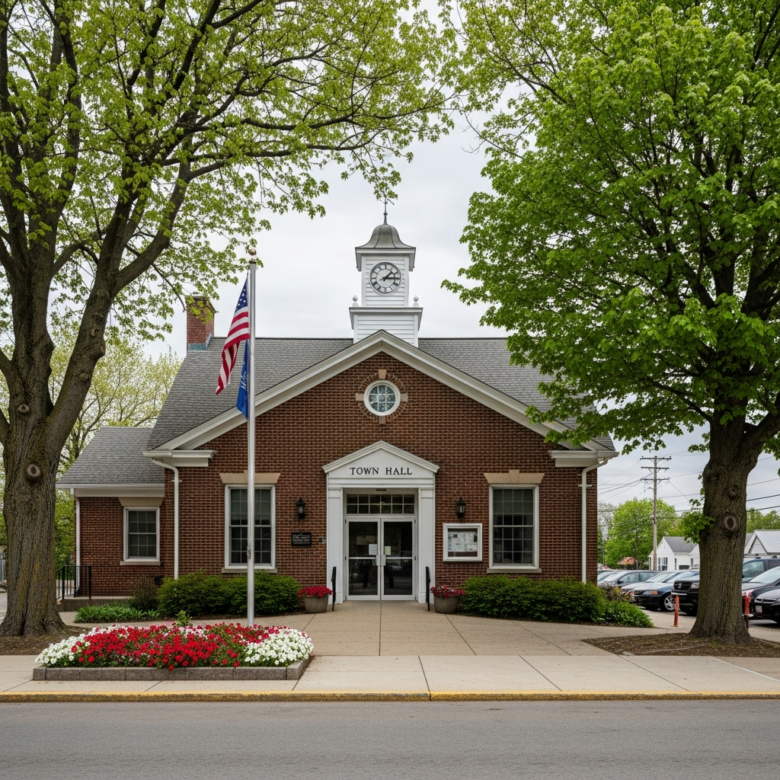
Five months into Toni Sturm’s first year as supervisor, Wilton’s Democratic-led board has reorganized committees, pushed code revisions, tightened at least one internal control, advanced accessibility work and started longer-range planning. But many of its biggest moves remain groundwork rather than finished results.
Wilton’s Democratic takeover was politically significant, but its first months in power have looked more like a managerial reset than a revolution. Since taking office Jan. 1, Supervisor Toni Sturm and the new board majority have reorganized committees, pushed code revisions, tightened at least one internal control, advanced accessibility work and begun longer-range planning on emergency services and transportation. The record so far suggests a government changing tone and process faster than it has changed outcomes.
A political reset — but not a blank slate
The political change is clear, even if one oft-repeated talking point is not. Available reporting confirms that Democrats swept Wilton’s 2025 supervisor and town-council races, flipping control of the board. The current roster shows Sturm as supervisor, with Connor Rohan and Joe Keneally on the Town Board, giving Democrats a 3-2 working majority. The reviewed sources do not independently confirm the broader claim that this is Wilton’s first Democratic majority in “almost 50 years,” but they do show a sharp break from the town’s recent political history. (Times Union; Town of Wilton board roster)
That timing matters because Sturm did not inherit a blank slate. Wilton adopted its 2026 final budget on Nov. 6, 2025, while John Lant was still supervisor and before the new board took office. Any fair assessment of the first months of 2026 therefore has to separate governing style and priority-setting, which belong to Sturm’s administration, from much of the town’s baseline spending plan, which does not. (Town Board minutes, Nov. 6, 2025)
It also matters that the new board did not take over a town in obvious fiscal distress. Wilton’s 2024 audited financial report gave the town a clean opinion, showed total net position of about $32.9 million, and reported a General Fund surplus that brought accumulated fund balance to roughly $18.1 million. Democrats inherited unresolved policy fights and infrastructure needs, but not a financial emergency. (2024 Audited Financial Report)
What the Sturm board has changed
1. It reorganized Town Hall and created new channels for policy work
At its Jan. 8 organizational meeting, the new board did more than pass annual housekeeping resolutions. It installed Rohan as deputy supervisor, reappointed the Ethics Advisory Board, and set a committee structure that signaled where the new majority wanted to spend attention. Most notably, the board created Alternative Transportation and Land Conservation committees while assigning liaisons to safety review, emergency services, code revision, wildlife-preserve matters and other operational areas. In local government, procedure often becomes policy: it determines what gets studied, who reports back and what reaches the board. (Town Board minutes, Jan. 8, 2026)
That committee-heavy style continued through the spring. By May, Rohan was reporting on active code and zoning revision work, while Keneally was reporting on both alternative transportation and a newly convened emergency-services planning effort. Across the minutes, the pattern is consistent: this administration is trying to build a more formal pipeline from issue identification to public board action. Whether residents see that as thoughtful or overly process-driven will depend on how much patience they have for groundwork. (Town Board minutes, May 7, 2026)
2. It tightened at least one internal control
One of the clearest governance changes came in March, when the board rescinded a January resolution and then voted that the comptroller could countersign checks but the supervisor’s signature stamp could not be used. The posted minutes do not explain the reversal, so it would be wrong to overread it. Still, the change points to a board that wanted a more explicit approval chain and a cleaner internal-control posture than the one it had approved two months earlier. (Town Board minutes, Jan. 8, 2026; Town Board minutes, March 5, 2026 draft)
That same March meeting also set an annual ethics-training date for board members and participating fire-department personnel. On its own, that is minor. In context, it fits the same pattern: the Sturm board has spent noticeable time on institutional housekeeping, compliance and formal process. Residents looking for dramatic headlines may not find much excitement there. Residents who care about how town government is run may see an early positive. (Town Board minutes, March 5, 2026 draft)
3. It has been more willing to escalate lingering code problems
One of the stronger accomplishment claims for the new administration concerns code enforcement. In November 2025, before Democrats took office, a resident publicly accused the town of years of failed enforcement at 716 Wilton-Gansevoort Road, citing runoff, sewage and occupancy issues and calling the town’s handling a “breakdown in accountability.” Four months later, the Sturm board authorized Supreme Court litigation over unresolved violations at the same property after earlier enforcement efforts had failed. (Town Board minutes, Nov. 6, 2025; Town Board minutes, March 5, 2026 draft)
That does not mean the problem is solved. It does mean the administration moved beyond routine local enforcement into a more serious legal posture. Compared with the late Lant-era record reflected in the minutes, that is a meaningful shift in approach: not necessarily more ideological, but more willing to use the town’s legal tools when ordinary compliance efforts stall. (Town Board minutes, March 5, 2026 draft)
4. It has pushed the code book, especially on temporary merchants and battery storage
By late spring, the board had also moved substantive code changes onto the agenda. On temporary merchants, Rohan argued that Wilton’s rules were more cumbersome than necessary. The proposed rewrite would extend the certificate period from five months to six and remove repeated Planning Board review for merchants who continue to meet the rules, while still requiring property-owner permission, insurance and town certification. That is less an ideological change than a regulatory-streamlining effort. (Town Board minutes, May 7, 2026)
The more consequential code move is the proposed 12-month moratorium on battery energy storage systems, or BESS. The May minutes show the board framing that pause not as a ban, but as time to study battery chemistry, fire risk, emergency-response demands, siting rules and public input. That is a defensible precautionary approach, especially given responder concerns about thermal runaway and specialized firefighting needs. But a moratorium is, by definition, a delay. Supporters can call it prudent; critics can call it hesitation. Both readings have support in the record. (Town Board minutes, May 7, 2026)
The board also approved Compliance Engine software to track commercial fire inspections. The public record offers limited detail on cost and implementation, but the move fits the same broader theme: greater attention to the town’s regulatory and inspection infrastructure. (Town Board minutes, April 2, 2026 draft)
5. It has made accessibility a real priority
If there is one area where the Sturm administration has shown a clear value shift, it is accessibility. In February, town officials discussed automatic-door access, the shortcomings of town buildings as voting locations, and the need to think beyond sidewalks to actual building entry. By May, the board had authorized bidding for ADA-compliant automatic doors at Town Hall, Town Court, the Senior Center, Gavin Park and the Highway Department, with an estimated installation cost of roughly $8,000 per door. (Town Board minutes, Feb. 5, 2026; Town Board minutes, May 7, 2026)
This is not glamorous work. It is, however, tangible and resident-facing. It also compares favorably with the kind of issue local governments often discuss for years without acting on. Here, Wilton moved from discussion in February to a bid request in May. That is a real accomplishment, even if the installations themselves still lie ahead. (Town Board minutes, Feb. 5, 2026; Town Board minutes, May 7, 2026)
6. It has leaned into longer-range planning on parks, bikes and emergency services
The board’s record also shows a future-oriented streak. In February and March, officials discussed the fact that Gavin Park’s comprehensive plan has not been updated since 2005 and began talking about a new master-planning effort tied to changing recreation demand and limited remaining space. In May, Keneally reported that the Alternative Transportation Committee was preparing to seek a county trails grant for bicycle-access improvements at Gavin Park after consulting the town’s insurance broker, who said the changes would not increase liability exposure. (Town Board minutes, Feb. 5, 2026; Town Board minutes, May 7, 2026)
Emergency planning may be the best example of that longer-horizon focus. After a cardiac-arrest save at Gavin Park, the board discussed AED coverage, CPR training and possible Narcan planning for town buildings. By May, Keneally’s emergency-services committee was looking at volunteer recruitment, potential tax incentives, hydrant and site-access standards, and the long-term condition of the Wilton Emergency Corps building — including whether a future EMS facility could also serve as a more capable emergency operations center than the conference room now designated at Town Hall. (Town Board minutes, April 2, 2026 draft; Town Board minutes, May 7, 2026)
The criticism is obvious: these are committees, concepts and planning frameworks, not ribbon cuttings. But local governments often fail precisely because they do not think five and 10 years ahead. On emergency services, the Sturm board is at least trying to do that. (Town Board minutes, May 7, 2026)
7. It has continued — and in places sharpened — Wilton’s conservation and civic-partnership work
The new board has also acted on land conservation and civic partnerships. In April it approved a $95,000 pass-through tied to Saratoga PLAN’s Klepetar Family Forest conservation easement, helping protect 444 acres under Saratoga County’s farmland/open-space program. In May it approved an MOU with the Wilton Wildlife Preserve and Park under which the town would provide in-kind demolition and rough grading for a Camp Saratoga building project while the preserve covers construction and debris removal, with state-grant reimbursement potentially supporting part of the work. (Town Board minutes, April 2, 2026 draft; Town Board minutes, May 7, 2026)
These actions matter, though they represent more continuity than rupture. Wilton already had a history of working with conservation and preserve partners. What the Sturm board appears to be doing is giving those efforts more explicit political attention and linking them to newer priorities such as trail access, land-conservation committees and broader recreation planning. (Town Board minutes, Jan. 8, 2026; Town Board minutes, May 7, 2026)
What has not changed much
The clearest limit on the Sturm administration is that Wilton’s underlying development and fiscal trajectory still looks more inherited than reinvented. The town’s 2023 development report showed a strong pipeline of residential and commercial activity, with 166 building permits and 442 certificates issued that year. In 2024, the Town Board approved the Wilton Mall redevelopment in a 4-1 vote over Lant’s opposition, with Ray O’Conor warning that leaving the property idle risked an “economic black hole.” That matters because it shows Wilton’s development politics were already shifting before Sturm took office — and because some members of the current governing coalition were part of that earlier turn. (Development Report 2023; Times Union)
So far, there is no sign that the Democratic administration is trying to halt growth or unwind major prior approvals. If anything, the May minutes suggest the opposite: officials are talking about code modernization, sign rules, lighting, solar gaps and even “hamlet-style zoning” to encourage more village-like mixed-use areas. That points to a board more interested in shaping growth than stopping it. (Town Board minutes, May 7, 2026)
The same continuity appears in public safety. Wilton renewed a 2026 sheriff’s contract for one patrol, weekdays from 8 a.m. to 4 p.m., at a cost of $142,523.85. The sheriff’s office also gave the board a March presentation about assigning a consistent deputy to town. That is not insignificant, but neither is it a sweeping expansion of police coverage. It is better understood as a modest service arrangement within existing county structures. (Town Board minutes, April 2, 2026 draft)
And on infrastructure, the biggest headaches remain unresolved. North Road was described in March as beyond ordinary repair and in need of full-depth reconstruction; the highway superintendent said the town might have to close it if nothing is done. That issue captures the administration’s central challenge: the board may be active and organized, but it is still hemmed in by expensive inherited problems that cannot be solved with committee appointments and code hearings alone. (Town Board minutes, March 5, 2026 draft)
Compared with prior leadership: more shift in tone than in fundamentals
The fairest comparison is this: the Lant years left Wilton with a strong balance sheet and an active development pipeline, but also with unresolved code-enforcement frustrations, infrastructure burdens and a governing style that many voters evidently wanted to change. The Sturm board’s early months suggest a government that is more process-conscious, more willing to revisit internal controls, more interested in accessibility and alternative transportation, and more inclined to formalize long-range planning through committees and public hearings. (2024 Audited Financial Report; Town Board minutes, Jan. 8, 2026)
But the differences should not be exaggerated. Wilton under Democratic leadership has not, in five months, become a fundamentally different town. Taxes have not been remade. Development has not been halted. The budget was largely inherited. Some of the board’s most visible accomplishments remain preparatory rather than complete. Even former supervisor John Lant, as quoted by the Times Union, described Sturm as someone whose “heart is in the job” and who was adapting well. That is probably the best shorthand for the administration’s first phase: earnest, active and methodical, but not yet transformative. (Times Union)
The verdict so far
If Wilton voters ask whether Democrats have accomplished anything noteworthy, the honest answer is yes — mostly in the form of groundwork. They have reorganized Town Hall, advanced code revisions, tightened one internal-control practice, escalated at least one longstanding enforcement case, pushed accessibility improvements into the procurement stage, started substantive emergency-services planning, and continued conservation and recreation partnerships. Those are real actions. (Town Board minutes, Jan. 8, 2026; Town Board minutes, May 7, 2026)
If voters ask whether Democratic leadership has already changed Wilton in a dramatic way, the answer is not yet. The record is stronger on direction than on finished outcomes, stronger on governance than on marquee wins, and stronger on identifying future risks than on solving the town’s oldest, most expensive problems.
That may be enough for supporters, who can plausibly argue the board is finally doing the slow work of modernizing local government. It may not be enough for skeptics, who can just as plausibly say Wilton has gained more committees than concrete results. Because Sturm’s term ends on Dec. 31, 2026 under the state’s even-year election transition, she does not have the luxury of a long honeymoon. By November, voters will be deciding not just whether the town’s tone has changed, but whether that early planning has started to produce results. (Even-Year Elections Transition Guidance)
I worried about what Democrats would look like running Wilton and voted Lant but these people seem reasonable. Things happen quicker than they before and nothing looney. I am a lifelong conservative but I like some of the things they are doing.