

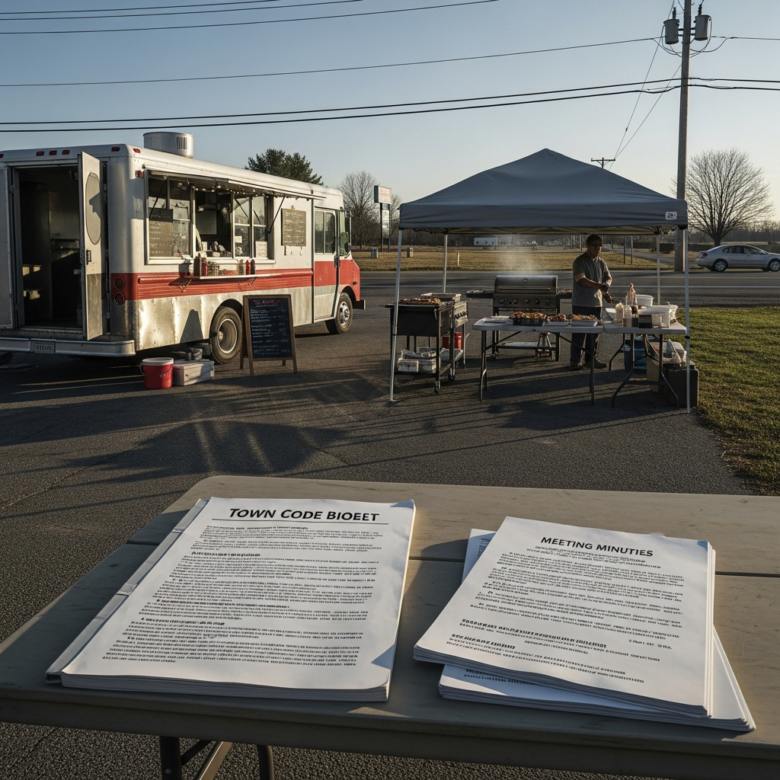
Late-posted Planning Board minutes show Wilton again waived its one-temporary-merchant-per-lot rule for Romeo Soriano at 892 Route 9, even as the town is separately rewriting its temporary-merchant law.
Wilton’s Planning Board quietly approved another waiver for Manilla Grill at 892 Route 9, letting Romeo Soriano operate two temporary merchants on the same lot despite code language that normally limits a lot to one. The decision, buried in final April 15 minutes posted in late May, comes while town officials are simultaneously revising the temporary-merchant law itself.
One of the more revealing small-town-government stories in Wilton right now is not a major subdivision or a flashy corridor project. It is a temporary-merchant waiver.
According to final Planning Board minutes from April 15, 2026, the board approved Romeo Soriano’s request for a waiver from Town Code §129-169 B.(3) so that two temporary merchants can operate on the same lot at 892 Route 9.
Why this stands out
The minutes say the code normally limits a lot to one temporary merchant.
They also say this is not the first time the board has bent that rule for this applicant. The board had granted the same waiver in 2025, and it did so again this year.
That raises an obvious question: if the waiver keeps making sense, why is the underlying rule still written so tightly?
The larger context
This is not happening in isolation.
Wilton’s Code & Zoning Revision Committee said on May 11 that the town’s temporary-merchants local law had received minor edits from the town attorney and was headed to public hearing. In other words, Wilton is still working on the permanent rules while the Planning Board continues to handle exceptions under the current code.
That may be legally normal. It is also a good example of how local government often operates:
- adopt a restrictive baseline rule,
- make ad hoc exceptions when reality gets in the way,
- then promise a cleaner rewrite later.
What the public record does — and does not — say
The posted minutes do not show a long policy debate. They simply note the code limit, the repeat waiver, and the board’s approval.
That means residents can see the result, but not much about:
- why the one-merchant rule exists in the first place,
- why this lot keeps qualifying for an exception, or
- whether the rule is being applied consistently town-wide.
Why readers should care
Temporary merchants are a small subject until they are not.
These rules affect:
- roadside commerce,
- small business flexibility,
- how much discretion the town keeps for itself, and
- whether similarly situated applicants get similar treatment.
A clean code should not force people to ask for repeat mercy if the use is plainly workable. If Wilton’s rewrite is serious, one test will be whether it reduces this kind of waiver-by-waiver governance instead of just repackaging it.
What to watch next
The next thing to watch is the Town Board public hearing on the rewritten temporary-merchants law. If the new draft still leaves basic seasonal commerce dependent on board discretion, then the town will have changed the paperwork more than the policy.
Why is everything “quietly?” They talk about these things openly in public meetings and then post summaries of those meetings online. What would it look like to do something sufficiently loudly? Planning board meets in your living room? Calls every resident to let them know that two vendors are going to temporarily share a lot?
Haha, good question. Let me fix that.