

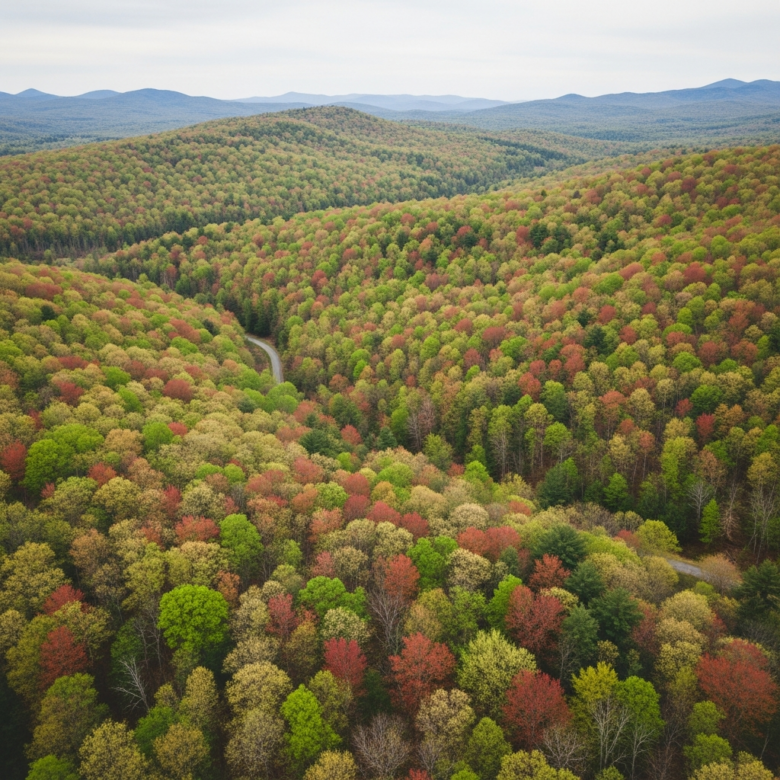
Draft April 2 Town Board minutes show Wilton formally stepping through a $95,000 payment-and-reimbursement arrangement tied to Saratoga PLAN’s 444-acre Klepetar forest protection project.
A land-conservation deal celebrated earlier this year by Saratoga PLAN also came with a quieter municipal step: draft April 2 Town Board minutes show Wilton approved a resolution requiring the town to remit $95,000 tied to the Klepetar Family Forest easement project, after which the county would reimburse the town the same amount once documentation is complete.
Wilton’s April 2 Town Board draft minutes add a local-government layer to the already announced Klepetar Family Forest conservation project.
The minutes show the board approving Resolution #127, which lays out how the town fits into the financing and paperwork for protection of 444 acres of forestland associated with the Klepetar Family Forest easement project.
What the town approved
According to the draft minutes:
- the project involves 444 acres of mature hardwoods,
- the easement covers parcels in Wilton and Greenfield,
- the Town of Wilton would remit $95,000 to Saratoga PLAN, and
- Saratoga County would then issue a $95,000 payment back to the town once proof of completion and remittance is provided.
In other words, the town is not being portrayed as making a simple one-way subsidy. But it is playing a real transactional role that residents would not necessarily know about from the celebratory conservation announcement alone.
What Saratoga PLAN said publicly
In January, Saratoga PLAN announced that 444 acres in the southern Palmertown area had been permanently protected from development pressure. The group framed the project as a major conservation win and said the landowners hope to work toward future trail access.
That hope matters — but it is not the same as a guaranteed public right.
The town resolution described in the April 2 minutes says the deeds will contain conservation easements in perpetuity for agriculture, open space, recreation, or park purposes. That is a real land-use restriction. But the town record excerpt does not by itself promise immediate public access, trail construction, or public management obligations.
Why this deserves a closer look
Open-space deals are often sold in broad, agreeable terms: preserve land, stop overdevelopment, protect the landscape. Fair enough.
But even popular conservation projects deserve plain-English answers on basic questions:
- What exactly is the town paying, and when?
- Is the town fronting money temporarily or taking on long-term exposure?
- What public benefit is legally guaranteed versus merely hoped for?
- Who maintains or enforces the easement over time?
Those are not anti-conservation questions. They are just the questions residents should ask whenever public bodies enter funding chains and permanent land restrictions.
Analysis
The project may be worthwhile. It may even be an unusually strong value if it blocks future development pressure at a modest direct town cost.
But Wilton’s role should not have to be reconstructed from scattered records. If a town resolution is part of the machinery, the town should explain:
- the money flow,
- the legal effect,
- the public-access reality,
- and any continuing municipal obligations.
That kind of transparency is especially important when officials can count on public goodwill toward preservation and therefore face less scrutiny than they would on a new road, building, or patrol contract.
What to watch next
Residents should watch for:
- recorded easement documents,
- any future trail-access proposal,
- town or county reimbursement confirmation,
- and whether Wilton treats the land as a future public recreation asset or simply as protected private open space.
Those are different outcomes, and the town should be explicit about which one residents are actually getting.