

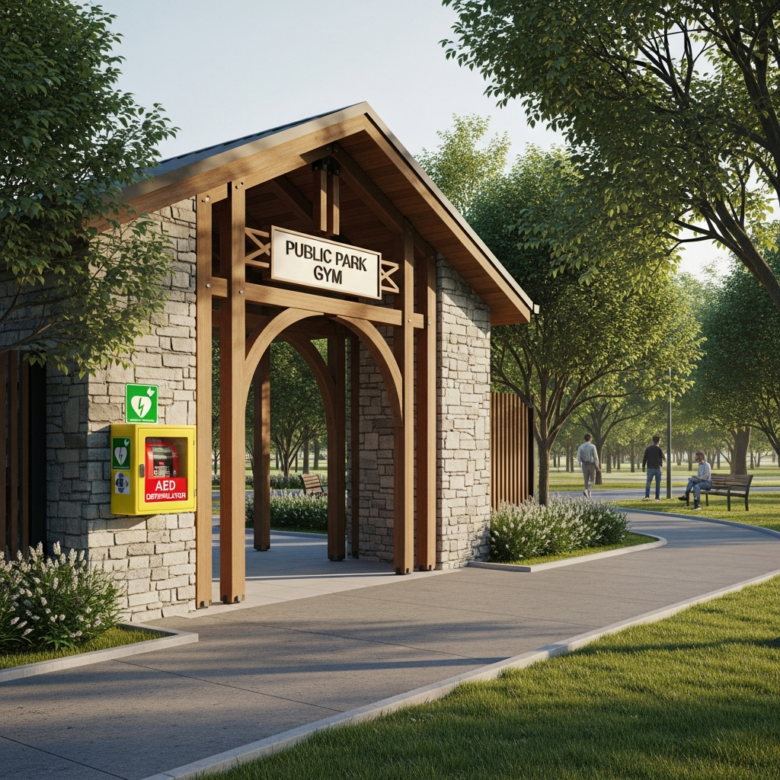
Draft April 2 Town Board minutes say bystanders revived a man at Gavin Park with CPR and an on-site AED, pushing officials into a broader discussion about AED coverage, training and Narcan across town facilities.
One of the more revealing public-safety moments in Wilton this spring did not come from a budget line or a grant announcement. It came from an emergency at Gavin Park. According to draft April 2 Town Board minutes, a man went into cardiac arrest while playing basketball, and bystanders used CPR and the park’s on-site AED before first responders arrived.
The outcome appears to have been far better than it could have been.
The draft April 2 Town Board minutes say the bystanders immediately started CPR, called 911, retrieved the automated external defibrillator (AED), and used it. By the time responders arrived, the man had regained a pulse and was breathing. The board said it wanted to formally recognize the bystanders for their actions.
Why this matters beyond one incident
The same discussion showed how quickly a real-world emergency exposes practical gaps in local government preparedness.
According to the minutes, the AED had to be taken temporarily out of service until the next morning so EMS could replace pads and check the device. Officials then discussed whether all town buildings have AEDs, whether enough staff in each building are trained, and whether the town should broaden planning to include Narcan as another life-saving tool.
That is a useful shift in focus. Emergency readiness is not mainly about having a device in a building. It is about whether someone nearby knows what to do, whether backup equipment and supplies are ready, and whether town facilities are covered consistently rather than by accident.
What the board discussion suggests
The April 2 discussion suggests Wilton is now thinking more seriously about:
- AED coverage across multiple buildings
- keeping CPR/AED training current for more than one employee per site
- whether opioid-overdose response tools should be part of the same readiness plan
Those are basic operational questions, but they are the kind of basics that matter when seconds count.
Bottom line
This was not a theoretical safety exercise. It was a reminder that the most valuable local-government spending is sometimes the unglamorous kind: working equipment, trained people, and a plan that holds up when something goes wrong.