

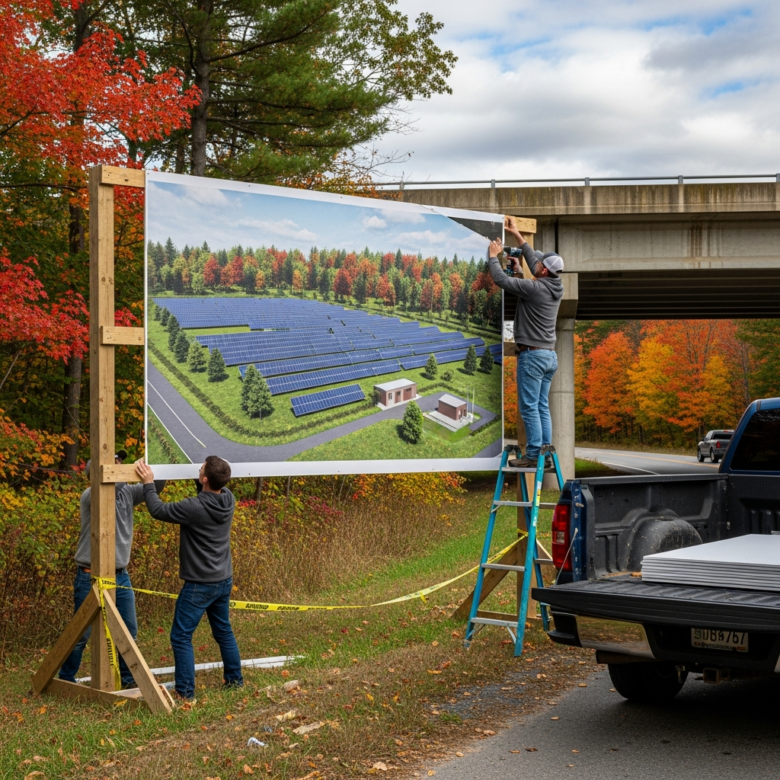
Town records show the Quaker Springs community-solar proposal near Perry Road and Jones Road was withdrawn in January, ending at least for now a project that had already gone through Planning Board review and variance work.
A 5-megawatt community-solar proposal in Wilton appears to be off the table, at least for now. Newly accessible Town Board minutes from Jan. 8, 2026 say Town Counsel Mark Schachner told officials that the Quaker Springs Solar application was being withdrawn — a quiet ending to a project that had been moving through town review since late 2022.
A project that once looked active has now disappeared from the front burner
The Quaker Springs Solar proposal was not some stray one-meeting concept.
Town Planning Board minutes from December 21, 2022 described it as a proposed 5 MW solar facility on roughly 39.3 acres over two parcels near Jones Road, Perry Road and I-87. The application materials said it would connect through National Grid infrastructure and operate as a community-solar project offering bill savings to subscribers.
By January 18, 2023, the Planning Board was discussing shifts to the layout and recommending the project to the Zoning Board of Appeals, or ZBA (Zoning Board of Appeals), for variance relief.
A later 2024 visual-impact memo shows the project was still active enough to be planning balloon-and-tarp demonstration days for public viewing.
Then, on January 8, 2026, Wilton’s Town Board minutes recorded a blunt update: town counsel had received notice that day that the application was being withdrawn.
What the earlier records show
The project had already raised many of the now-familiar solar questions:
- setbacks from property lines;
- buffering near nearby homes and the Northway corridor;
- access issues;
- impacts on forest and farmland;
- Wilton’s broader discomfort with multiple solar proposals arriving in a short period.
Those 2023 minutes are revealing because they capture officials openly talking about a possible town moratorium while the Quaker Springs project was still advancing. In other words, applicants were already being warned that the regulatory climate could shift while they were spending time and money in review.
The withdrawal was not described as permanent
One important nuance: the January 8 Town Board minutes do not say the applicant abandoned the idea forever.
According to the minutes, Schachner said the applicant’s wording was essentially that it would not be continuing forward “at this point” and wanted to withdraw the application.
That leaves open the possibility of a future return, whether in revised form or under a different policy landscape.
Why this matters beyond one solar farm
This is a useful case study in how Wilton handles large land-use questions.
From the public’s perspective, the project moved through the system for years, generated technical review, raised policy concerns and then quietly fell away without a big final public accounting of:
- what killed it;
- how much redesign was attempted;
- whether the problem was economics, interconnection, local regulation or simple applicant fatigue.
That opacity cuts both ways. Neighbors deserve closure, and property owners deserve to know whether Wilton’s approval process is predictable enough to justify the cost of applying.
The timing is notable
The withdrawal also lands in an interesting policy moment.
Wilton is now moving toward a public hearing on a draft battery energy storage system moratorium. So while one concrete solar project has faded out, the town is still actively tightening or reworking its rules around energy infrastructure.
That does not mean the moratorium caused this withdrawal. The records here do not prove that.
But the sequence does show a broader reality: Wilton’s energy-project debate has not gone away. The town is still rewriting the rules, and applicants are still absorbing the uncertainty.
Questions worth asking now
If officials want this outcome to be understood as a normal application withdrawal rather than another example of murky local process, they should answer a few basic questions:
- Did the applicant cite a primary reason for withdrawing?
- Did Wilton expect the project to return in revised form?
- How much staff and consultant time was spent reviewing it?
- What lessons, if any, is the town carrying into its current energy-code work?
A project can fail for legitimate reasons. But in local government, quiet endings are rarely the same thing as transparent ones.