

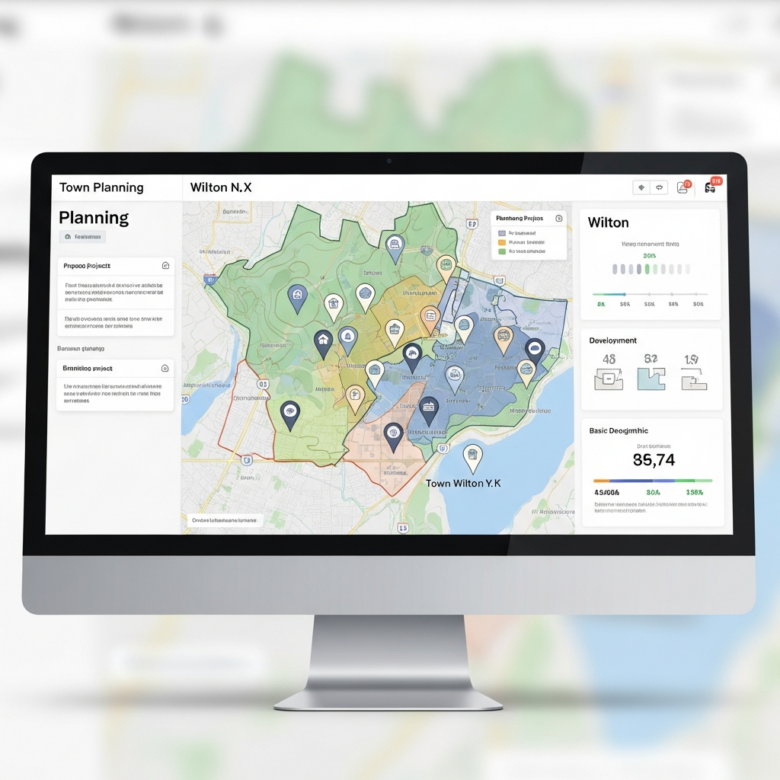
The town’s planning pages now point residents to a 2025 annual development report and promote a single online resource center for agenda maps, project maps, and growth records.
Wilton’s planning pages now link to an “Annual Development Report 2025,” and town promotional material is steering residents to a centralized online development portal with an interactive agenda map, active-and-approved project map, and annual growth reporting. It is a useful transparency move, even if the town still prefers dashboards and marketing language over blunt plain-English explanations of what all that growth means.
For residents trying to keep up with Wilton’s steady buildout, the town has quietly made one thing easier: finding the paperwork in one place.
By May 2, 2026, Wilton’s Annual Development Reports page was linking to an Annual Development Report 2025. Around the same time, the town’s newsletter was promoting a Planning Department “resource center” built around three main tools:
- an interactive agenda map for Planning Board items,
- a project map for active and approved development, and
- access to the annual development report.
Why this matters
Wilton has long had the raw ingredients of a growth record: agendas, minutes, maps, and project files. The problem has often been fragmentation. Residents had to know where to look, what board mattered, and which PDF or map layer actually answered the question.
This new setup suggests the town is trying to package growth information more coherently.
That is a real improvement.
It also fits the broader pattern we’ve seen this spring, as Wilton has surfaced:
- a town-wide traffic planning study,
- an approved development map showing cumulative approvals,
- draft code chapters from the zoning rewrite, and now
- a current annual development report plus a more marketable project portal.
The good news
A centralized planning portal can help residents do basic oversight before a hearing instead of after a vote.
If the tools work well, they should make it easier to answer questions like:
- What is currently before the Planning Board?
- What has already been approved nearby?
- How much residential and commercial growth has been recorded recently?
- Which parts of town are seeing the most cumulative pressure?
That is the kind of public-facing information a growing town should offer without residents filing FOIL requests or hunting through old minutes.
The limitation
There is still a difference between displaying information and explaining it.
Wilton’s public-facing language around planning tends to be upbeat and managerial. The town describes its growth as thoughtful, balanced, and aligned with long-range planning. Maybe some of it is. But residents still need simple, direct answers to harder questions:
- Which projects added the most traffic burden?
- How much permitting revenue did the town actually collect?
- What public costs may follow private approvals?
- Where is the town adding housing fastest relative to road, drainage, and service capacity?
A dashboard can help. It can also function as a polished wrapper around data the public still has to interpret alone.
What to watch next
The practical test is whether Wilton keeps this portal updated and whether the annual report becomes a real accountability document instead of just a planning brochure.
If the town is serious about transparency, the next step should be obvious: pair the maps and annual report with a short plain-English summary of what changed in 2025, where the pressure points are, and what taxpayers may be expected to absorb next.
Analysis
This is one of the better kinds of local-government transparency: not performative hearings, but easier access to records people actually use. The weakness is familiar too. Government often gets more comfortable publishing tools than publishing conclusions.