

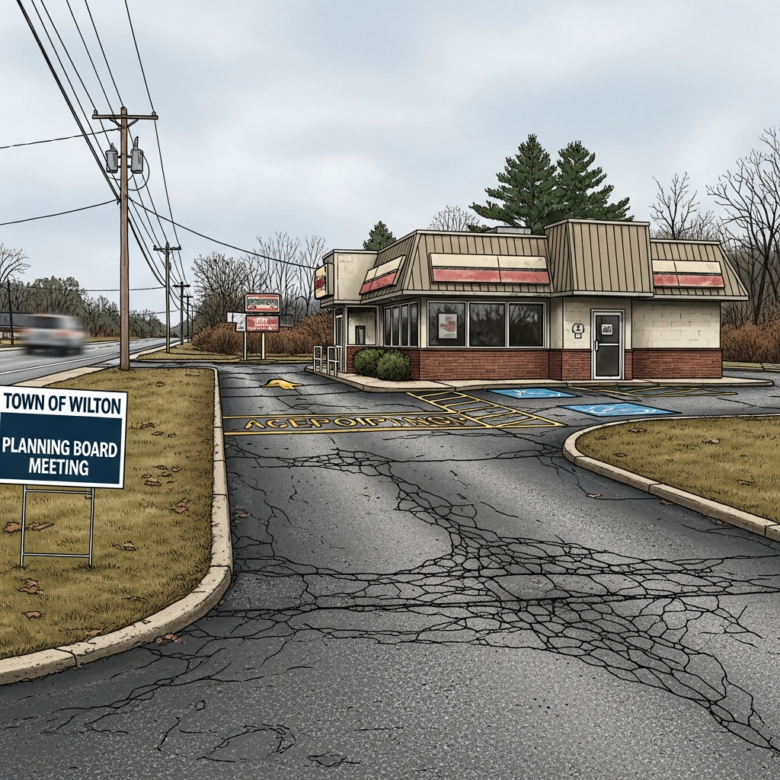
The Planning Board signed off on the LongHorn Steakhouse conversion at 3062 Route 50, but tied occupancy to repairs of the worn entrance roadway.
Wilton’s approved March 18 Planning Board minutes show the former TGI Fridays site at 3062 Route 50 has been cleared for conversion to a LongHorn Steakhouse, but the town attached an unusually practical condition: no certificate of occupancy until the battered Route 50 entrance is repaired.
In a town where plenty of land-use conditions amount to landscaping trivia, Wilton’s Planning Board used its March 18 approval of the proposed LongHorn Steakhouse in a more concrete way.
The board approved an amended site plan for the conversion of the former TGI Fridays on Route 50, but the approval came with a notable requirement: the restaurant’s certificate of occupancy will be conditioned on repairs to the entrance roadway from Route 50.
What the project includes
According to the approved minutes, the proposal involved:
- converting the former TGI Fridays building for LongHorn Steakhouse
- reducing seating from 220 to 180
- slight building-size reduction
- restriping and parking adjustments
- ADA and takeout-parking changes
- signage and site maintenance work
The board said no new or different environmental impacts required further SEQRA review.
Why the entrance mattered
The minutes show the main issue was not steakhouse branding or menu traffic. It was the poor condition of the Route 50 entrance roadway, which sits outside the tenant’s immediate lease area.
That creates a familiar suburban-commercial problem: the visible business wants to open, but the access infrastructure may be controlled by a landlord or larger property owner. Everyone benefits from the site. No one wants to own the repair bill.
Wilton’s answer was straightforward. If the entrance is bad enough to be part of the public discussion, then opening the new restaurant should not be fully separated from fixing it.
A fair condition — but only if enforced
This is the kind of condition local boards often avoid because it creates friction with landlords, chains, and multi-tenant property owners. Here, the board actually used leverage.
From a small-l libertarian perspective, that is one of the better uses of municipal power: not symbolic regulation, but requiring a property owner and tenant to address a basic access problem before the town signs off.
The catch is obvious. A condition only matters if Wilton follows through.
If the entrance gets patched only cosmetically, or if the town quietly relaxes the standard later, then the requirement was mostly theater. If the repair is real, residents and customers may get a better and safer entrance than they would have otherwise.
What to watch now
Residents should watch for:
- actual roadway repair work at the Route 50 entrance
- any building permit or certificate-of-occupancy activity tied to the site
- whether the landlord, not just the tenant, is visibly involved in the fix
The biggest lesson is simple: Wilton did not merely approve another chain restaurant reuse. It used the approval to force attention to a long-ignored access problem.
That may be more useful than a hundred pages of planning language no one remembers after the meeting ends.