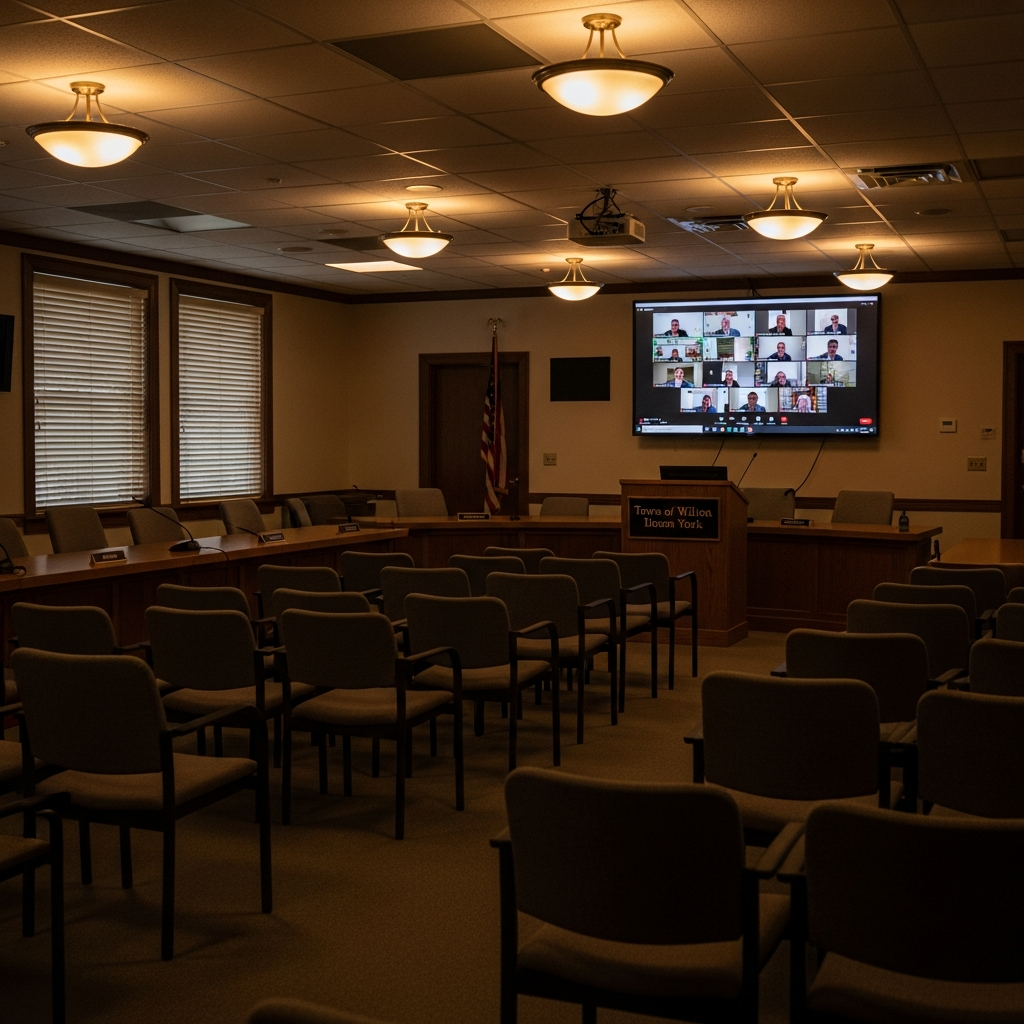
A late‑February legal notice confirms the Town Board’s March 5, 2026 meeting will be held virtually, reviving concerns about how easy it is for residents to watch—and influence—key local decisions.
For the first time in a while, Wilton’s Town Board will not gather in the Town Hall meeting room for its regular first‑Thursday session. A legal notice posted February 27, 2026 announces that the March 5 meeting will be held as a virtual session, with residents expected to log in remotely rather than show up on Traver Road.
What the notice says
A public notice on the town website, labeled as the Town Board Agenda – 03‑05‑26 Public Notice Virtual Meeting, states that the board will hold its regularly scheduled March 5, 2026 meeting as a virtual session. The document functions as both the agenda posting and a legal notice of the remote format.
While the town has used virtual and hybrid formats before, this is the first clearly advertised virtual‑only Town Board meeting of 2026. The notice is dated February 27, 2026, leaving roughly a week for residents to discover and plan for the change.
Key fact: The agenda page explicitly characterizes March 5 as a virtual meeting, rather than simply providing an optional livestream.
What’s not clear from the posting
The public notice improves on Wilton’s earlier habit of posting sparse or late agendas, but it still leaves several practical questions unanswered:
-
How can residents watch?
The notice text (as posted online) does not prominently list a Zoom link, livestream URL, or clear instructions for how to connect, raising the possibility that key access details may be buried in an attached PDF or added later. -
Will public comment be possible?
There is no obvious explanation of how public comment will work in a virtual format—whether residents can speak live, must submit written comments in advance, or will be limited to watching. -
Is this a one‑off or a new pattern?
The town’s meeting calendar still shows the first‑Thursday Town Board slot at Town Hall, and there is no parallel announcement that future meetings will remain virtual.
From a transparency standpoint, the fact that residents must click into a specific agenda page to discover that a meeting is virtual—rather than seeing that plainly signaled on the main calendar—adds friction at exactly the point where participation is already harder.
Why virtual format matters
For a small town, the shift from in‑person to virtual can have real consequences:
-
Barrier to spontaneous participation.
Walking into Town Hall on a Thursday night is straightforward. Finding the right link, ensuring a device works, and troubleshooting audio can be enough to deter less tech‑savvy residents from weighing in on taxes, zoning, or local laws. -
Potential for procedural glitches.
Remote meetings can create confusion about when a public hearing is open or closed, whether comments via chat count as part of the record, and how to handle technical failures mid‑vote. -
Reduced informal accountability.
In‑person meetings allow residents to read body language, see who shows up, and engage board members before or after the gavel. Virtual meetings compress everything into a single video window controlled by the town.
From a small‑l libertarian perspective, any change that makes it less convenient for ordinary people to observe and question their local government should be met with healthy skepticism—especially when big spending, zoning, or enforcement powers might be on the agenda.
The broader pattern: incremental but uneven transparency
The virtual‑meeting notice lands in the middle of a slow, uneven improvement in Wilton’s online records:
- The Meeting Agendas page now lists agendas and related documents for early‑2026 meetings of the Town Board, Planning Board, and ZBA, which is more than residents had during much of 2025.
- Draft minutes for at least one recent Zoning Board of Appeals session (February 26, 2026) have been posted online.
Yet this progress sits atop a still‑confusing web structure—with separate pages for agendas, minutes, videos, and board‑specific archives—that forces residents to click through multiple menus just to understand what their government is doing.
Questions residents may want answered
For the March 5 virtual meeting and beyond, residents might reasonably press the Town Board and staff to clarify:
- Will a livestream link or dial‑in number be clearly posted on both the calendar and agenda page at least 24–48 hours before the meeting?
- How will public comment be handled in a way that is at least as open as in‑person comment periods?
- Is the town planning a return to in‑person meetings after March 5, or will remote sessions be used more often?
- Will video recordings be posted promptly and clearly labeled, and will written minutes still be produced in full?
A simple FAQ added to the town website—spelling out how virtual meetings work, what rights residents retain, and where to find links—would go a long way toward ensuring that moving online doesn’t quietly reduce scrutiny of the Town Board’s decisions.